menus

slider

Tuesday, 3 May 2016

MIDDLE-CLASS AMERICANS

Since 2013, the federal reserve board has conducted a survey to “monitor the financial and economic status of American consumers.” Most of the data in the latest survey, frankly, are less than earth-shattering: 49 percent of part-time workers would prefer to work more hours at their current wage; 29 percent of Americans expect to earn a higher income in the coming year; 43 percent of homeowners who have owned their home for at least a year believe its value has increased. But the answer to one question was astonishing. The Fed asked respondents how they would pay for a $400 emergency. The answer: 47 percent of respondents said that either they would cover the expense by borrowing or selling something, or they would not be able to come up with the $400 at all. Four hundred dollars! Who knew?
Well, I knew. I knew because I am in that 47 percent.
I know what it is like to have to juggle creditors to make it through a week. I know what it is like to have to swallow my pride and constantly dun people to pay me so that I can pay others. I know what it is like to have liens slapped on me and to have my bank account levied by creditors. I know what it is like to be down to my last $5—literally—while I wait for a paycheck to arrive, and I know what it is like to subsist for days on a diet of eggs. I know what it is like to dread going to the mailbox, because there will always be new bills to pay but seldom a check with which to pay them. I know what it is like to have to tell my daughter that I didn’t know if I would be able to pay for her wedding; it all depended on whether something good happened. And I know what it is like to have to borrow money from my adult daughters because my wife and I ran out of heating oil.
You wouldn’t know any of that to look at me. I like to think I appear reasonably prosperous. Nor would you know it to look at my résumé. I have had a passably good career as a writer—five books, hundreds of articles published, a number of awards and fellowships, and a small (very small) but respectable reputation. You wouldn’t even know it to look at my tax return. I am nowhere near rich, but I have typically made a solid middle- or even, at times, upper-middle-class income, which is about all a writer can expect, even a writer who also teaches and lectures and writes television scripts, as I do. And you certainly wouldn’t know it to talk to me, because the last thing I would ever do—until now—is admit to financial insecurity or, as I think of it, “financial impotence,” because it has many of the characteristics of sexual impotence, not least of which is the desperate need to mask it and pretend everything is going swimmingly. In truth, it may be more embarrassing than sexual impotence. “You are more likely to hear from your buddy that he is on Viagra than that he has credit-card problems,” says Brad Klontz, a financial psychologist who teaches at Creighton University in Omaha, Nebraska, and ministers to individuals with financial issues. “Much more likely.” America is a country, as Donald Trump has reminded us, of winners and losers, alphas and weaklings. To struggle financially is a source of shame, a daily humiliation—even a form of social suicide. Silence is the only protection.
I know what it’s like to have to borrow money from my daughters because my wife and I ran out of heating oil.
So I never spoke about my financial travails, not even with my closest friends—that is, until I came to the realization that what was happening to me was also happening to millions of other Americans, and not just the poorest among us, who, by definition, struggle to make ends meet. It was, according to that Fed survey and other surveys, happening to middle-class professionals and even to those in the upper class. It was happening to the soon-to-retire as well as the soon-to-begin. It was happening to college grads as well as high-school dropouts. It was happening all across the country, including places where you might least expect to see such problems. I knew that I wouldn’t have $400 in an emergency. What I hadn’t known, couldn’t have conceived, was that so many other Americans wouldn’t have the money available to them, either. My friend and local butcher, Brian, who is one of the only men I know who talks openly about his financial struggles, once told me, “If anyone says he’s sailing through, he’s lying.” That might not be entirely true, but then again, it might not be too far off.
Part of the reason I hadn’t known is that until fairly recently, economists also didn’t know, or, at the very least, didn’t discuss it. They had unemployment statistics and income differentials and data on net worth, but none of these captured what was happening in households trying to make a go of it week to week, paycheck to paycheck, expense to expense. David Johnson, an economist who studies income and wealth inequality at the University of Michigan, says, “People studied savings and debt. But this concept that people aren’t making ends meet or the idea that if there was a shock, they wouldn’t have the money to pay, that’s definitely a new area of research”—one that’s taken off since the Great Recession. According to Johnson, economists have long theorized that people smooth their consumption over their lifetime, offsetting bad years with good ones—borrowing in the bad, saving in the good. But recent research indicates that when people get some money—a bonus, a tax refund, a small inheritance—they are, in fact, more likely to spend it than to save it. “It could be,” Johnson says, “that people don’t have the money” to save. Many of us, it turns out, are living in a more or less continual state of financial peril. So if you really want to know why there is such deep economic discontent in America today, even when many indicators say the country is heading in the right direction, ask a member of that 47 percent. Ask me.
Financial impotence goes by other names: financial fragility, financial insecurity, financial distress. But whatever you call it, the evidence strongly indicates that either a sizable minority or a slim majority of Americans are on thin ice financially. How thin? A 2014 Bankrate survey, echoing the Fed’s data, found that only 38 percent of Americans would cover a $1,000 emergency-room visit or $500 car repair with money they’d saved. Two reports published last year by the Pew Charitable Trusts found, respectively, that 55 percent of households didn’t have enough liquid savings to replace a month’s worth of lost income, and that of the 56 percent of people who said they’d worried about their finances in the previous year, 71 percent were concerned about having enough money to cover everyday expenses. A similar study conducted by Annamaria Lusardi of George Washington University, Peter Tufano of Oxford, and Daniel Schneider, then of Princeton, asked individuals whether they could “come up with” $2,000 within 30 days for an unanticipated expense. They found that slightly more than one-quarter could not, and another 19 percent could do so only if they pawned possessions or took out payday loans. The conclusion: Nearly half of American adults are “financially fragile” and “living very close to the financial edge.” Yet another analysis, this one led by Jacob Hacker of Yale, measured the number of households that had lost a quarter or more of their “available income” in a given year—income minus medical expenses and interest on debt—and found that in each year from 2001 to 2012, at least one in five had suffered such a loss and couldn’t compensate by digging into savings.
You could think of this as a liquidity problem: Maybe people just don’t have enough ready cash in their checking or savings accounts to meet an unexpected expense. In that case, you might reckon you’d find greater stability by looking at net worth—the sum of people’s assets, including their retirement accounts and their home equity. That is precisely what Edward Wolff, an economist at New York University and the author of a forthcoming book on the history of wealth in America, did. Here’s what he found: There isn’t much net worth to draw on. Median net worth has declined steeply in the past generation—down 85.3 percent from 1983 to 2013 for the bottom income quintile, down 63.5 percent for the second-lowest quintile, and down 25.8 percent for the third, or middle, quintile. According to research funded by the Russell Sage Foundation, the inflation-adjusted net worth of the typical household, one at the median point of wealth distribution, was $87,992 in 2003. By 2013, it had declined to $54,500, a 38 percent drop. And though the bursting of the housing bubble in 2008 certainly contributed to the drop, the decline for the lower quintiles began long before the recession—as early as the mid-1980s, Wolff says.
Wolff also examined the number of months that a family headed by someone of “prime working age,” between 24 and 55 years old, could continue to self-fund its current consumption, presuming the liquidation of all financial assets except home equity, if the family were to lose its income—a different way of looking at the emergency question. He found that in 2013, prime-working-age families in the bottom two income quintiles had no net worth at all and thus nothing to spend. A family in the middle quintile, with an average income of roughly $50,000, could continue its spending for … six days. Even in the second-highest quintile, a family could maintain its normal consumption for only 5.3 months. Granted, those numbers do not include home equity. But, as Wolff says, “it’s much harder now to get a second mortgage or a home-equity loan or to refinance.” So remove that home equity, which in any case plummeted during the Great Recession, and a lot of people are basically wiped out. “Families have been using their savings to finance their consumption,” Wolff notes. In his assessment, the typical American family is in “desperate straits.”
Certain groups—African Americans, Hispanics, lower-income people—have fewer financial resources than others. But just so the point isn’t lost: Financial impotence is an equal-opportunity malady, striking across every demographic divide. The Bankrate survey reported that nearly half of college graduates would not cover that car repair or emergency-room visit through savings, and the study by Lusardi, Tufano, and Schneider found that nearly one-quarter of households making $100,000 to $150,000 a year claim not to be able to raise $2,000 in a month. A documentary drawing on Lusardi’s work featured interviews with people on the street in Washington, D.C., asking whether they could come up with $2,000. Lusardi, who was quick to point out that a small number of passerby interviews should not be mistaken for social science, was nonetheless struck by the disjuncture between the appearance of the interviewees and their answers. “You look at these people and they are young professionals,” Lusardi said. “You expect that people would say, ‘Of course I would come up with it.’ ” But many of them couldn’t.
In the 1950s and ’60s, American economic growth democratized prosperity. In the 2010s, we have managed to democratize financial insecurity.
If you ask economists to explain this state of affairs, they are likely to finger credit-card debt as a main culprit. Long before the Great Recession, many say, Americans got themselves into credit trouble. According to an analysis of Federal Reserve and TransUnion data by the personal-finance site ValuePenguin, credit-card debt stood at about $5,700 per household in 2015. Of course, this figure factors in all the households with a balance of zero. About 38 percent of households carried some debt, according to the analysis, and among those, the average was more than $15,000. In recent years, while the number of people holding credit-card debt has been decreasing, the average debt for those households carrying a balance has been on the rise.
Part of the reason credit began to surge in the ’80s and ’90s is that it was available in a way it had never been available to previous generations. William R. Emmons, an assistant vice president and economist for the Federal Reserve Bank of St. Louis, traces the surge to a 1978 Supreme Court decision, Marquette National Bank of Minneapolis v. First of Omaha Service Corp. The Court ruled that state usury laws, which put limits on credit-card interest, did not apply to nationally chartered banks doing business in those states. That effectively let big national banks issue credit cards everywhere at whatever interest rates they wanted to charge, and it gave the banks a huge incentive to target vulnerable consumers just the way, Emmons believes, vulnerable homeowners were targeted by subprime-mortgage lenders years later. By the mid-’80s, credit debt in America was already soaring. What followed was the so-called Great Moderation, a generation-long period during which recessions were rare and mild, and the risks of carrying all that debt seemed low.
Financial impotence has many of the characteristics of sexual impotence, not least of which is the desperate need to mask it.
Both developments affected savings. With the rise of credit, in particular, many Americans didn’t feel as much need to save. And put simply, when debt goes up, savings go down. As Bruce McClary, the vice president of communications for the National Foundation for Credit Counseling, says, “During the initial phase of the Great Recession, there was a spike in credit use because people were using credit in place of emergency savings. They were using credit as a life raft.” Not that Americans—or at least those born after World War II—had ever been especially thrifty. The personal savings rate peaked at 13.3 percent in 1971 before falling to 2.6 percent in 2005. As of last year, the figure stood at 5.1 percent, and according to McClary, nearly 30 percent of American adults don’t save any of their income for retirement. When you combine high debt with low savings, what you get is a large swath of the population that can’t afford a financial emergency.
So who is at fault? Some economists say that although banks may have been pushing credit, people nonetheless chose to run up debt; to save too little; to leave no cushion for emergencies, much less retirement. “If you want to have financial security,” says Brad Klontz, “it is 100 percent on you.” One thing economists adduce to lessen this responsibility is that credit represents a sea change from the old economic system, when financial decisions were much more constrained, limiting the sort of trouble that people could get themselves into—a sea change for which most people were ill-prepared.
It is ironic that as financial products have become increasingly sophisticated, theoretically giving individuals more options to smooth out the bumps in their lives, something like the opposite seems to have happened, at least for many. Indeed, Annamaria Lusardi and her colleagues found that, in general, the more sophisticated a country’s credit and financial markets, the worse the problem of financial insecurity for its citizens. Why? Lusardi argues that as the financial world has grown more complex, our knowledge of finances has not kept pace. Basically, a good many Americans are “financially illiterate,” and this illiteracy correlates highly with financial distress. A 2011 study she and a colleague conducted measuring knowledge of fundamental financial principles (compound interest, risk diversification, and the effects of inflation) found that 65 percent of Americans ages 25 to 65 were financial illiterates.

Choice, often in the face of ignorance, is certainly part of the story. Take me. I plead guilty. I am a financial illiterate, or worse—an ignoramus. I don’t offer that as an excuse, just as a fact. I made choices without thinking through the financial implications—in part because I didn’t know about those implications, and in part because I assumed I would always overcome any adversity, should it arrive. I chose to become a writer, which is a financially perilous profession, rather than do something more lucrative. I chose to live in New York rather than in a place with a lower cost of living. I chose to have two children. I chose to write long books that required years of work, even though my advances would be stretched to the breaking point and, it turned out, beyond. We all make those sorts of choices, and they obviously affect, even determine, our bottom line. But, without getting too metaphysical about it, these are the choices that define who we are. We don’t make them with our financial well-being in mind, though maybe we should. We make them with our lives in mind. The alternative is to be another person.
But even having made those choices, which involved revolving credit, for the better part of my life I was not drowning in debt (maybe treading in it … okay, barely treading). Until about five years ago, when I stopped using my credit cards altogether and started paying them off little by little with the help of a financial counselor, I’d always managed to pay at least the monthly minimum and sometimes more. I didn’t have savings, but not because I thought I could rely forever on credit instead or because I chose to spend my money extravagantly rather than salt it away. In retrospect, of course, my problem was simple: too little income, too many expenses. Credit enabled me to forestall this problem for a time—and also to make it progressively worse—but the root of the problem was deeper.
In the 1950s and ’60s, economic growth democratized prosperity. In the 2010s, we have democratized financial insecurity.
I never figured that I wouldn’t earn enough. Few of us do. I thought I’d done most of the right things. I went to college; got a graduate degree; taught for a while; got a book contract; moved to a small, inexpensive, rent-controlled apartment in Little Italy to write; got married; and bumped along until I landed a job on television (those of you with elephant memories may remember that for three years, I was one of the replacements for Gene Siskel and Roger Ebert on the PBS movie-review show Sneak Previews). Then my wife and I bought a small co‑op apartment in Brooklyn, which we could afford, and had our two daughters. My wife continued to work, and we managed to scrape by, though child care and then private schools crimped our finances. No, we didn’t have to send our girls to private schools. We could have sent them to the public school in our neighborhood, except that it wasn’t very good, and we resolved to sacrifice our own comforts to give our daughters theirs. Some economists attribute the need for credit and the drive to spend with the “keeping up with the Joneses” syndrome, which is so prevalent in America. I never wanted to keep up with the Joneses. But, like many Americans, I wanted my children to keep up with the Joneses’ children, because I knew how easily my girls could be marginalized in a society where nearly all the rewards go to a small, well-educated elite. (All right, I wanted them to be winners.)
Still, we moved to the tip of Long Island, in East Hampton, where we wouldn’t have to pay that exorbitant private-school tuition and where my wife could eventually quit her job as a film executive to be with the children, the loss of her income offset a little by not having to pay for child care. (When people look at me admiringly after I tell them I live in the Hamptons, I always add, “We live there full-time like the poor people, not only in the summer like the rich people.”) We rented a house and made a go of it. After Martin Scorsese bought the movie rights to my biography of the gossip columnist Walter Winchell, we even managed to put together a down payment to buy the house we’d been renting.
But the problem with finances is that life doesn’t cooperate. In our case—and I have a feeling in the case of just about every American—there were unforeseen circumstances. I couldn’t sell our co‑op in the city, because the co‑op board kept rejecting the buyers, which meant I had to carry two mortgages for years. The housing market in New York soured, and I eventually sold the apartment for a steep loss, because I had no choice. I suppose I could have slashed the price sooner to bring in more would-be buyers—in retrospect, that would have been the wisest choice—but I wanted to cover what I owed the bank. I lost my television job because, I was told, I wasn’t frivolous enough for the medium, which was probably true. (Or at least I felt better thinking it was true.) I still had my books, but they took longer to write than I had calculated, and cutting corners to turn them out faster, I knew, would be cutting off my career. (I tell the M.F.A. writing students whom I now teach, part-time, that anyone can write a book quickly: Just write a bad book.) The girls grew up, but my wife had been out of the workforce so long that she couldn’t get back into her old career, and her skills as a film executive limited her options. In any case, with my antediluvian masculine pride at stake, I told her that I could provide for us without her help—another instance of hiding my financial impotence, even from my wife. I kept the books; I kept her in the dark.
And then, on top of it all, came the biggest shock, though one not unanticipated: college. Because I made too much money for the girls to get more than meager scholarships, but too little money to afford to pay for their educations in full, and because—another choice—we believed they had earned the right to attend good universities, universities of their choice, we found ourselves in a financial vortex. (I am not saying that universities are extortionists, but … universities are extortionists. One daughter’s college told me that because I could pay my mortgage, I could afford her tuition.) In the end, my parents wound up covering most of the cost of the girls’ educations. We couldn’t have done it any other way. Although I don’t have any regrets about that choice—one daughter went to Stanford, was a Rhodes Scholar, and is now at Harvard Medical School; the other went to Emory, joined WorldTeach and then AmeriCorps, got a master’s degree from the University of Texas, and became a licensed clinical social worker specializing in traumatized children—paying that tariff meant there would be no inheritance when my parents passed on. It meant that we had depleted not only our own small savings, but my parents’ as well.
There was worse to come. Because I lived largely off the advances my publisher paid me when I commenced research on a book, the bulk of my earnings were lumped into a single year, even though the advance had to be amortized to last the years it would take to write the book. That meant I was hit by a huge tax bill that first year that I could not pay in full without cannibalizing what I needed to finish the book. When I began writing a biography of Walt Disney, as my two daughters headed toward college, I decided to pay whatever portion of my taxes I could, then pay the remainder, albeit with penalties added, when the book was published and I received my final payment. The problem is that the penalty meter keeps running, which means that the arrears continue to grow, which means that I continue to have to pay them—I cannot, as it happens, pay them in full. I suppose that was a choice, too: pay my taxes in full, or hold back enough to write the book and pay my mortgage and buy groceries. I did the latter.
And so the hole was dug. And it was deep. And we may never claw our way out of it.
Perhaps none of this would have happened if my income had steadily grown the way incomes used to grow in America. It didn’t, and they don’t. There was a good year here or there—another television job, a new book contract, that movie sale. But mostly my wages remained steady, which meant that, when adjusted for inflation, their buying power dipped. For magazine pieces, I was making exactly what I had made 20 years earlier. And I wasn’t alone. Real hourly wages—that is, wage rates adjusted for inflation—peaked in 1972; since then, the average hourly wage has essentially been flat. (These figures do not include the value of benefits, which has increased.)
And so the hole was dug. And it was deep. And we may never claw our way out of it.
Looking at annual inflation-adjusted household incomes, which factor in the number of hours worked by wage earners and also include the incomes of salaried employees, doesn’t reveal a much brighter picture. Though household incomes rose dramatically from 1967 to 2014 for the top quintile, and more dramatically still for the top 5 percent, incomes in the bottom three quintiles rose much more gradually: only 23.2 percent for the middle quintile, 13.1 percent for the second-lowest quintile, and 17.8 percent for the bottom quintile. That is over a period of 47 years! But even that minor growth is somewhat misleading. The peak years for income in the bottom three quintiles were 1999 and 2000; incomes have declined overall since then—down 6.9 percent for the middle quintile, 10.8 percent for the second-lowest quintile, and 17.1 percent for the lowest quintile. The erosion of wages is something over which none of us has any control. The only thing one can do is work more hours to try to compensate. I long since made that adjustment. I work seven days a week, from morning to night. There is no other way.
And still it isn’t enough.
In a 2010 report titled “Middle Class in America,” the U.S. Commerce Department defined that class less by its position on the economic scale than by its aspirations: homeownership, a car for each adult, health security, a college education for each child, retirement security, and a family vacation each year. By that standard, my wife and I do not live anywhere near a middle-class life, even though I earn what would generally be considered a middle-class income or better. A 2014 analysis by USA Today concluded that the American dream, defined by factors that generally corresponded to the Commerce Department’s middle-class benchmarks, would require an income of just more than $130,000 a year for an average family of four. Median family income in 2014 was roughly half that.
In my house, we have learned to live a no-frills existence. We halved our mortgage payments through a loan-modification program. We drive a 1997 Toyota Avalon with 160,000 miles that I got from my father when he died. We haven’t taken a vacation in 10 years. We have no credit cards, only a debit card. We have no retirement savings, because we emptied a small 401(k) to pay for our younger daughter’s wedding. We eat out maybe once every two or three months. Though I was a film critic for many years, I seldom go to the movies now. We shop sales. We forgo house and car repairs until they are absolutely necessary. We count pennies.
I don’t ask for or expect any sympathy. I am responsible for my quagmire—no one else. I didn’t get gulled into overextending myself by unscrupulous credit merchants. Basically, I screwed up, royally. I lived beyond my means, primarily because my means kept dwindling. I didn’t take the actions I should have taken, like selling my house and downsizing, though selling might not have covered what I owed on my mortgage. And let me be clear that I am not crying over my plight. I have it a lot better than many, probably most, Americans—which is my point. Maybe we all screwed up. Maybe the 47 percent of American adults who would have trouble with a $400 emergency should have done things differently and more rationally. Maybe we all lived more grandly than we should have. But I doubt that brushstroke should be applied so broadly. Many middle-class wage earners are victims of the economy, and, perhaps, of that great, glowing, irresistible American promise that has been drummed into our heads since birth: Just work hard and you can have it all.
If there is any good news, it is that even as wages have stagnated, a lot of things, especially durable goods like TVs and computers, have been getting steadily cheaper. So, by and large, has clothing (though prices have risen modestly in recent years). Housing costs, as measured by the price per square foot of a median-priced and median-sized home, have been stable, even accounting for huge variations from one real-estate market to another. But some things, like health care and higher education, cost more—a lot more. And, of course, these are hardly trivial items. Life happens, and it happens to cost a lot—sometimes more than we can pay.
Yet even that is not the whole story. Life happens, yes, but shit happens, too—those unexpected expenses that are an unavoidable feature of life. Four-hundred-dollar emergencies are not mere hypotheticals, nor are $2,000 emergencies, nor are … well, pick a number. The fact is that emergencies always arise; they are an intrinsic part of our existence. Financial advisers suggest that we save at least 10 to 15 percent of our income for retirement and against such eventualities. But the primary reason many of us can’t save for a rainy day is that we live in an ongoing storm. Every day, it seems, there is some new, unanticipated expense—a stove that won’t light, a car that won’t start, a dog that limps, a faucet that leaks. And those are only the small things. In a survey of American finances published last year by Pew, 60 percent of respondents said they had suffered some sort of “economic shock” in the past 12 months—a drop in income, a hospital visit, the loss of a spouse, a major repair. More than half struggled to make ends meet after their most expensive economic emergency. Even 34 percent of the respondents who made more than $100,000 a year said they felt strain as a result of an economic shock. Again, I know. After the job loss, the co‑op board’s rejections, the tax penalties, there was one more wallop: A publisher with whom I had signed a book contract, and from whom I had received an advance, sued me to have the advance returned after I missed a deadline. (Book deadlines are commonly missed and routinely extended.)
In effect, economics comes down to a great Bruce Eric Kaplan New Yorker cartoon that was captioned: “We thought it was a rough patch, but it turned out to be our life.”
Our life. And for many of us—we silent sufferers who cannot speak about our financial tribulations—it is our lives, not just our bank accounts, that are at risk. The American Psychological Association conducts a yearly survey on stress in the United States. The 2014 survey—in which 54 percent of Americans said they had just enough or not enough money each month to meet their expenses—found money to be the country’s No. 1 stressor. Seventy-two percent of adults reported feeling stressed about money at least some of the time, and nearly a quarter rated their stress “extreme.” Like financial fragility itself, that stress cut across income levels and age cohorts. Not surprisingly, too much stress is bad for one’s health—as, of course, is too little money. Thirty-two percent of the survey respondents said they couldn’t afford to live a healthy lifestyle, and 21 percent said they were so financially strapped that they had forgone a doctor’s visit, or considered doing so, in the previous year.
Perhaps none of this would have happened if my income had grown the way incomes used to grow in America. It didn’t, and they don’t.
But financial fragility’s most insidious effects extend beyond physical health, to our larger sense of well-being. “Financial insecurity is associated with depression, anxiety, and a loss of personal control that leads to marital difficulties,” says Brad Klontz, the financial psychologist. I know about that, too. Money may change everything, as Cyndi Lauper sang. But lack of money definitely ruins everything. Financial impotence casts a pall of misery. It keeps you up at night and makes you not want to get up in the morning. It forces you to recede from the world. It eats at your sense of self-worth, your confidence, your energy, and, worst of all, your hope. It is ruinous to relationships, turning spouses against each other in tirades of calumny and recrimination, and even children against parents, though thankfully that is one thing that never happened to me. The rest, however, did happen and still does. I consider myself pretty tough and resilient. What of those who aren’t? To fail—which, by many economic standards, a very large number of Americans do—may constitute our great secret national pain, one that is deep and abiding. We are impotent.
And while the affliction is primarily individual and largely hidden from public view, it has perhaps begun to diminish our national spirit. People want to feel,need to feel, that they are advancing in this world. It is what sustains them. They need to feel that their lives will improve, and, even more, that the lives of their children will be better than theirs, just as they believed that their own lives would be better than their parents’. But people increasingly do not feel that way. A 2014New York Times poll found that only 64 percent of Americans said they believed in the American dream—the lowest figure in nearly two decades. I suspect our sense of impotence in the face of financial difficulty is not only a source of disillusionment, but also a source of the anger that now infects our national politics, an anger that gets displaced onto undocumented immigrants or Chinese trade or President Obama precisely because we are unable or unwilling to articulate its true source. As the Harvard economist Benjamin M. Friedman wrote in his 2005 book, The Moral Consequences of Economic Growth, “Merely being rich is no bar to a society’s retreat into rigidity and intolerance once enough of its citizens lose the sense that they are getting ahead.” We seem to be at the beginning of just such a retreat today—at the point where simmering financial impotence explodes into political rage.
Many Americans still remain optimistic—at least publicly. In a 2014 Pew survey revealing that 55 percent of Americans spend as much as they make each month, or more, nearly the exact same percentage say they have favorable financial circumstances, which may just mean some of them are too frightened to admit they don’t. Or perhaps they are just too financially illiterate to understand the severity of their predicament. Many of the scholars I have talked with are optimistic too. “People have this ingenuity to solve so many problems,” Annamaria Lusardi told me. “I think we are finally getting it that the brain does not work around money naturally,” Brad Klontz said, believing that Americans are realizing they have to take more control of their financial lives.
But optimism won’t negate the fact that wages continue to stagnate; that the personal savings rate remains low; and that a middle-class life seems increasingly hard to maintain. (A pre-recession survey by the Consumer Federation of America and the Financial Planning Association found that 21 percent of Americans felt the “most practical” way for them to get several hundred thousand dollars was to win the lottery.) I try to hang on to hope myself while still being a realist. Yet hope doesn’t come easily anymore, even in a nation of dreamers and strivers and idealists. What so many of us have been suffering for so many years may just seem like a rough patch. But it is far more likely to be our lives.

Source: http://www.theatlantic.com/

Monday, 2 May 2016

MAHABALESHWAR – TOURIST SPOT

Image result for mahabaleshwar imagesMahabaleshwar is a beautiful city in Satara district in the state of Maharashtra (India). It is a hill station located in the Western Ghats range. With one of the few evergreen forests of India, it served as the summer capital of Bombay province during the British Raj.
 Located about 120 km (75 mi) southwest of Pune and 285 km (177 mi) from Mumbai, Mahabaleshwar is a vast plateau measuring 150 km2 (58 sq mi), bound by valleys on all sides. It reaches a height of 1,439 m (4,721 ft) at its highest peak above sea level, known as Wilson/Sunrise Point.
 Mahabaleshwar includes three villages: Malcolm Peth, Old “Kshetra” Mahabaleshwar and part of the Shindola village.
Mahabaleshwar is the source of the Krishna River that flows across Maharashtra, Karnataka, Telangana and Andhra Pradesh. The legendary source of the river is a spout from the mouth of a statue of a cow in the ancient temple of Mahadev in Old Mahabaleshwar. Legend has it that Krishna is Lord Vishnu himself as a result of a curse on the trimurtis by Savitri. Also, its tributaries Venna and Koyna are said to be Lord Shiva and Lord Brahma themselves. An interesting thing to notice is that 4 other rivers come out from the cow’s mouth apart from Krishna and they all travel some distance before merging into Krishna. These rivers are the Koyna, Venna (Veni), Savitri, and Gayatri.
  • Tourism in Mahabaleshwar
  • Old Mahabaleshwar
The old Mahabaleshwar is about 7 km from the Mahabaleshwar and there many places where international tourists can visit specially temples (4500 years old) with examples of old Indian architecture. Beautiful sceneries, natural view from Old Mahabaleshwar is something unique and one of the tourists attractions. Some of the natural views named by the British, who made their holidays in these places during the British Raj.
  • Krishnabai temple
Krishnabai temple is situated aside by Krishna river where Krishna river is worshiped. Krishnabai temple is built on the hilltop overlooking the Krishna valley and was built in 1888 by a ruler of Ratnagirion the Konkancoast. The temple consists of a Shiva Lingam and a statue of Krishna. A stream of water falls from a cow-face on a water tank which is knwon as Kunda in Hindi.
  • 3 Monkey Point
A route to Arthur’s Seat in Mahabaleshwar there is a natural sculpture of the stones which portraying 3 monkeys of Gandhi ji. So, the 3 nautral sculpture of stones named as 3 Monkey Point. This point can be figure out easily in the valleys.
  • Arthur seat point
Officer Sir Arthur Malet (1806–1888) (Not to be confused with British born actor of same name), who sat here and gazed at the Savitri River, where he lost his wife and children in a tragic ferry mishap.
  • Venna Lake
Mahabaleshwar has become one of the most popular tourist destination and honeymoon spot for the newly wed couples coming from all over the world. Venna lake has been surrounded by trees on all sides. Further, it is also a pilgrimage site for Hindus and Venna Lake is source of attraction for the international tourists. Tourists can find some budgetary hotels where you can have a view of the Venna lake and famous market of Mahabaleshwar.
  • Some other places to visit in Mahabaleshwar
View point
Kate’s Point – Kate’s point is located to the east of Mahabaleshwar and is famous for its view of two reservoirs, Balakwadi and Dhom. The point is around 1280 mts high.
Needle Hole Point / Elephant Point – This point is located near Kate’s point. It is natural rock formation and there is a hole between the rock, that’s thr reason behind its name “Needle Hole Point”.
Wilson Point – The name is given after Sir Leslie Wilson, who was the Governor of Bombay from 1923 to 1926. It is 1439 mtr high and the highest point in Mahabaleshwar.
Pratapgad – It is a fort nearby Mahabaleshwar built by Shivaji Maharaj and popular in History of India as Shivaji Maharaj defeat & killed Afzalkhan who was the Commander of Bijapur.
  • Some budget hotels in Mahabaleshwar:
  • Hotel Vyankatesh
  • Hotel Shreyas
  • Krishna Continental
  • Regal Hotel
  • Girivihar Hotel
  • Hotel Dreamland
  • Park Plaza Mahabaleshwar
  • Valley View Resort
  • How to get there?
By Road
Mahabaleshwar is located about 32 km from Wai. It is around 260 km from Mumbai, the state capital. The nearest major city is Satara, around 45 km away, and is 120 km from Pune. Mahabaleshwar is connected by the National Highway 4. Bus services by state-run MSRTC and private organizations connect it by buses from Pune, Mumbai, Sangli and Satara.
By Rail
Nearest railroad is Satara, around 53 km. Nearest major railway junctions include Pune (120 km), Miraj (170&km) and Sangli (165 km). Private cars and cabs, as well as state-run bus services are available in these locations to Mahabaleshwar. Also, a Rail station named Diwan Khavati on Kokan Railway near Khed gives a route of 60 km via Poladpur to Mahabaleshwar not so frequented though.
By Air
The nearest airport is Pune International Airport, serving the city of Pune, about 120 km from Mahabaleshwar. Chhatrapati Shivaji International Airport of Mumbai is 270 km away.
Source: http://www.excitingindia.in/tourist-spot/

HOW SAUDI ARABIA DANGEROUSLY UNDERMINES THE UNITED STATES

How Saudi Arabia dangerously undermines the United States(by Ralph Peters, NY Post) — Iran is our external enemy of the moment. Saudi Arabia is our enduring internal enemy, already within our borders and permitted to poison American Muslims with its Wahhabi cult.
Oh, and Saudi Arabia’s also the spring from which the bloody waters of global jihad flowed.
Iran humiliates our sailors, but the Saudis are the spiritual jailers of hundreds of millions of Muslims, committed to intolerance, barbarity and preventing Muslims from joining the modern world. And we help.
Firm figures are elusive, but estimates are that the Saudis fund up to 80% of American mosques, at least in part. And their goal is the same here as it is elsewhere in the world where Islam must compete with other religions: to prevent Muslims from integrating into the host society.
The Saudis love having Muslims in America, since that stakes Islam’s claim, but it doesn’t want Muslims to become Americans and stray from the hate-riddled cult they’ve imposed upon a great religion.
The tragedy for the Arabs, especially, has been who got the oil wealth. It wasn’t the sophisticates of Beirut or even the religious scholars of Cairo, but Bedouins with a bitter view of faith. The Saudis and their fellow fanatics in the oil-rich Gulf states have used those riches to drag Muslims backward into the past and to spread violent jihad.
The best argument for alternative energy sources is to return the Saudis to their traditional powerlessness.
I’ve seen Saudi money at work in country after country, from Senegal to Kenya to Pakistan to Indonesia and beyond. Everywhere, their hirelings preach a stern and joyless world, along with the duty to carry out jihad (contrary to our president’s nonsense, jihad’s primary meaning is not “an inner struggle,” but expanding the reach of Islam by fire and sword).
Here’s one of the memories that haunt me. On Kenya’s old Swahili Coast, once the domain of Muslim slavers preying on black Africans, I visited a wretched Muslim slum where children, rather than learning useful skills in a state school, sat amid filth memorizing the Koran in a language they could not understand. According to locals, their parents had been bribed to take their children out of the state schools and put them in madrassas.
Naturally, educated Christians from the interior get the good jobs down on the coast. The Muslims rage at the injustice. The Christians reply, “You can’t all be mullahs — learn something!” And behold: The Saudi mission’s accomplished, the society divided.
The Saudis build Muslims mosques and madrassas but not hospitals and universities.
The basic fact our policy-makers need to grasp about the Saudis is that they couldn’t care less about the welfare of flesh-and-blood Muslims (they refuse to take in Syrian refugees but demand Europe do so). What the Saudis care about is Islam in the abstract. Countless Muslims can suffer to keep the faith pure.
The Saudis build Muslims mosques and madrassas but not hospitals and universities.
Another phenomenon I’ve witnessed is that the Saudis rush to plant mosques where there are few or no Muslims, or where the Wahhabi cult still hasn’t found roots. In Senegal, with its long tradition of humane Islam, religious scholars dismiss the Saudis as upstarts. Yet, money ultimately buys souls and the Saudis were opening mosques.
And jihadi violence is now an appealing brand.
In Mombasa, Kenya, you drive past miles of near-empty mosques. Pakistan has been utterly poisoned, with Wahhabism pushing back even the radical (but less well-funded) Deobandis, the region’s traditional Islamist hardliners.
Shamelessly, the Saudis “offered” to build 200 new mosques in Germany for the wave of migrants. That was too much even for the politically correct Germans, and Chancellor Angela Merkel’s deputy had as close to a public fit over the issue as toe-the-line Germans are permitted to do.
But our real problem is here and now, in the United States. Consider how idiotic we’ve been, allowing Saudis to fund hate mosques and madrassas, to provide Jew-baiting texts and to do their best to bully American Muslims into conformity with their misogynistic, 500-lashes worldview. Our leaders and legislators have betrayed our fellow citizens who happen to be Muslim, making it more difficult for them to integrate fully into our society.
In the long run, the Saudis will lose. The transformative genius of America will defeat the barbarism. But lives will be wrecked along the way and terror will remain our routine companion.
Why did we let this happen? Greed. Naïveté. Political correctness. Inertia. For decades, the Saudis sent ambassadors who were “just like us,” drinking expensive scotch, partying hard, playing tennis with our own political royalty, and making sure that American corporations and key individuals made money. A lot of money.
But they weren’t just like us. First of all, few of us could afford the kind of scotch they drank. More important, they had a deep anti-American, anti-liberty, play-us-for-suckers agenda.
And we let the Saudis exert control over America’s Muslim communities through their surrogates. No restrictions beyond an occasional timid request to remove a textbook or pamphlet that went too far.
Think what we’re doing: The Saudis would never let us fund a church or synagogue in Saudi Arabia. There are none. And there won’t be any.
Wouldn’t it make sense for Congress to pass a law prohibiting foreign governments, religious establishments, charities and individuals from funding religious institutions here if their countries do not reciprocate and practice religious freedom? Isn’t that common sense? And simply fair?
Saudi money even buys our silence on terrorism.
Decades ago, the Saudi royal family realized it had a problem. Even its brutal practices weren’t strict enough for its home-grown zealots. So the king and his thousands of princes gave the budding terrorists money — and aimed them outside the kingdom.
Osama bin Laden was just one extremist of thousands. The 9/11 hijackers were overwhelmingly Saudi. The roots of the jihadi movements tearing apart the Middle East today all lie deep in Wahhabism.
Which brings us to 28 pages redacted from the 9/11 Commission’s report. Those pages allegedly document Saudi complicity. Our own government kept those revelations from the American people. Because, even after 9/11, the Saudis were “our friends.”
(We won’t even admit that the Saudi goal in the energy sector today is to break American fracking operations, let alone face the damage their zealotry has caused.)
There’s now a renewed push to have those 28 pages released. Washington voices “soberly” warn that it shouldn’t be done until after the president’s upcoming encounter with the Saudi king, if at all.
Do it now. Stop bowing. Face reality.
If we’re unlucky, we may end up fighting Iran, which remains in the grip of its own corrupt theocracy — although Iranian women can vote and drive cars, and young people are allowed to be young people at about the 1950s level. But if fortune smiles and, eventually, the Iranian hardliners go, we could rebuild a relationship with the Iranians, who are the heirs of a genuine, Persian civilization. Consider how successful and all-American Iranian-Americans have become.
War with Iran will remain a tragic possibility. But the Saudi war on our citizens, on mainstream Islam, and on civilization is a here-and-now reality.
Ralph Peters is a retired United States Army lieutenant colonel, author, and media commentator. 
Source: https://www.studentnewsdaily.com/

Sunday, 1 May 2016

NEGOTIATING CAR PRICE

Nowadays, when it comes time to buy a vehicle, we really do have a lot working in our favor, and a lot of resources at our disposal. There are multiple websites we can use to browse prices, deals, factory rebates, regional discounts—the whole gamut. When buying a vehicle, most consumers can be pretty well informed. But can they deal? Can you wheel and deal with a pro?
Even armed with the Kelly Blue Book values and the Edmunds "True Market Value," and having looked at a million deals online and in the classifieds, when it comes down to it, and you're sitting face to face with a professional car salesperson who haggles every single day, multiple times a day—do you have the gall to haggle with him?
When he says "I'm sorry, but that's what the car's worth," do you have what it takes to say, “You’re wrong?” I'm inclined to think that many do not.

Negotiating Down From the MSRP

You will inevitably wonder: What is a good price for this vehicle? What is a reasonable offer?
Suppose the vehicle’s MSRP—manufacturer’s suggested retail price—is $35,000, and I offer $25,000, what might happen? Are they going to laugh in my face, take away the beverage they graciously offered me, and have security escort me from the dealership?
Probably not. They probably won't offer you a $10,000 discount either, but they probably won't kick you off the lot.

Negotiating Makes Me Feel Funny. Isn't the Price on the Car the Actual Price?

It shouldn't. And, no, it's not.
Purchasing a new vehicle is not just a big expense, but an investment, and it is definitely a negotiable endeavor.
Certain purchases are non-negotiable. Like when you walk into Walmart, you can’t walk up to the guy and say, "Hey, I know that TV has a $2,000 price tag, but I'll give you $1,500 for it." They will simply say “No.” and let you walk. Same thing at the supermarket, and so on. They know someone will be along in the next minute paying the posted price.
But when you're spending tens of thousands of dollars on something, you better believe you should be negotiating, and they DO NOT want to let you walk.

What is the Function of a Car Salesman? What Is His Goal?

Many people think his goal is to sell vehicles. Wrong!
Selling vehicles is a given at a car or truck dealership. The salesperson wants more than that.
The goal of the car or truck salesman is to make the dealership the most profit possible, while also satisfying the customer. This might seem like a subtle point, but the distinction is important.
Conversely, what is the purpose of the buyer? What is his goal? Is it to acquire a new vehicle? No. That's a given. The buyer's goal is to negotiate the most favorable deal on the vehicle possible.
"Profit" is not a dirty word. Remember that. Don't be bitter, or feel disenfranchised, or get upset that the dealership is going to make money off your purchase, and that the salesman is going to benefit from your sale. Be happy, because it’s quite possible that you can get a good deal, and at the same time the dealership can make money, and the salesman can make a living. There can be a real balance here.
"Excessive profit" is definitely a dirty word. Excessive profit takes equity away from the buyer. No matter what, you want to avoid negative equity as much as possible.
I'm sure many of you have heard, or will hear, from a salesman, that your new vehicle is "an investment". They will use that word “investment” as a way to persuade you to purchase certain upsells, like warranties, roadside assistance packages, leather seats, accessories, insurance, and all sorts of other stuff. And a new vehicle can absolutely be an investment, for several reasons, but it’s a low-quality investment if you pay too much for it: if you get taken on the purchase price, gutted on your trade-in, and wheeled all the way into the driver's seat by paying MSRP for a new vehicle and accepting the KBB value for your trade. Read on.

What Is MSRP, Anyway?

MSRP is an acronym that stands for Manufacturer's Suggested Retail Price. This number is decided by the manufacturer—NOT the dealer.
The MSRP serves as a starting price for negotiations. Sometimes the dealer will post an "Invoice" price for the vehicle underneath the MSRP and use this as a selling point.
An exchange like the following is common ...
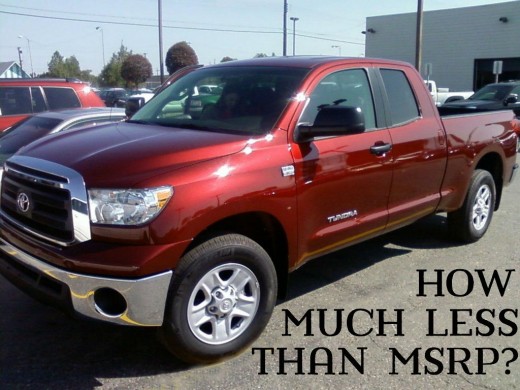
"Look at the invoice price," says Frank, of Bayside Toyota. "We're only making a few hundred dollars selling you this car at this price, and plus, you're getting almost one thousand dollars off MSRP."
"Oh," says Sally, as she fondles her hair nervously. "That's not too bad. I guess you can't really do much better than that, right?"
Frank smiles, thinking to himself, Excellent. We're done negotiating."Exactly. You know you're getting a good deal, and we've got to make a little something on the vehicle ..."
What Sally doesn't know is that Bayside Toyota gets a $2,000 rebate from the manufacturer every time they sell a vehicle like this. Plus, the Southeast Division of Toyota Dealerships rewards Bayside Toyota with another $3,000 of dealer cash incentive each time they sell a vehicle like this. Plus, this sale puts Bayside one vehicle closer to their corporate-mandated quota and dealer bonus check. Plus, they charge a $599.99 dealer fee (or something similar) on top of that.
Even at invoice price, the dealership might have anywhere between $2,000 and $4,000 dollars of profit to work with on a new vehicle. So imagine their margin at MSRP.

Strategies for Negotiating for a Car or Truck

You need strategies, because they have lots of strategies for how to sell to you. Some salesmen are highly trained salesmen, others are natural salesmen, and others are just going through the motions to feed their kids, but in general, salespeople have experience, knowledge, and a LOT of tricks of the trade.
What do you have? It better be more than jeans, a t-shirt, and some crumpled notes stuffed in your front pocket!
Here’s your plan:
1. Use the Internet
  • Shop your vehicle on the various consumer sites
  • Know what vehicle you want
  • Know the MSRP
  • Know the various options you want, which ones are most important, and what they cost (roughly)
  • Find enthusiast forums for the vehicle you're about to purchase, join the forum, tell them what you're doing, and ask for tips and hints. You'd be amazed what people in these places know about the industry!
  • Research your old car too, your trade-in. Know ALL THREE Kelly Blue Book values: Private Party, Dealer Trade-In, and Retail.
2. Know What You Can Spend
This seems like an obvious one, but whatever you do, DO NOT show up at the dealer without having firmly decided, yourself, "what your monthly payment could be.” This is a bear trap, and you will lose your leg.
3. Have Your Money
Deal with your own bank or credit union when it comes to financing. DO NOT go through the dealer. They use the terms of the loan as a bargaining trick, a price slider to confuse you, and in many cases they will mark up the interest rate they get from the lender.
Show up at the dealership with a Pre-Authorized Draft (a blank check from your bank, basically) and know that you are in charge.
Why are you in charge? Because you have the money.
I can just hear it now ... “But they have the car I want!” No. They have a car, a car that you want, and that they really want to sell you.
4. Be Upfront About Some Things
They will play psychological games with you. They're sizing you up, trying to figure you out, and trying to get you emotional about your purchase. Stay cooperative and down-to-earth. Let them know your intentions, and be honest about some facts. Tell them your name, and what you're looking for, and answer any general questions they might have.
  • For example, "I am going to buy a Toyota Camry today," is an honest statement. It clearly shows your intentions, and answers an unspoken question the salesman has: Is this person buying, or just shopping? Think about it. If a salesman is trying to make a profit, and he thinks he is getting shopped, are is he going to offer his best discounts? Probably not. He offers his best deals when he knows a purchase is going to happen.
  • "I'm working with several dealers right now, and I just want to be upfront about that. And, so far, I'm enjoying working with you." The first half of this statement had better be true, or I'm going to be VERY disappointed in you. If the second half of this statement is not true, do not buy from this dealership!
5. But Don't Show Your Hand
  • Don’t get swept away right off. Supposing he shows you the vehicle of your dreams. It's perfect, it’s amazing. You think, “I NEED IT!” But what should you say? Something like, “OK, I see it comes with leather seats . . . that's pretty nice. The color is okay, not the exact color I was thinking. Not bad." Do yourself a favor and do NOT gush over the vehicle and beg to drive it. Wait for the salesman to offer the test-drive. You want to appear logical, calculating, and in control the whole time. Someone who is emotional is more inclined to throw logic to the winds. And they know this, and feed off of it.
  • Be ready for this question, which they will definitely ask: "So what are you looking to spend?" Here, you have the advantage, because you know the answer. You know what you can spend, and you know what you want to spend. And they have nothing; that's why they’re asking the question. So don’t give up all you have unnecessarily.. If you can spend $25,000 to $30,000—the former being what you’d like to spend, and the latter pretty much breaking the bank—tell the salesman something like this. “Well, I really like this model, and this year, but this [other] model has this option that I really like. And you know, I'd like to come in right around twenty-two or twenty-three, depending on options and availability."
6. All the While, Watch the Numbers Carefully
Be ready with a pad of paper, and the whole time you’re in that cubicle working that deal, write down the numbers they tell you. You need to know the current figure of every number any time anything changes. That’s so they cannot inflate your trade allowance, and stuff it into the MSRP or the purchase price. Here are the typical numbers you need to be tracking:
  • MSRP (generally includes options, processing, and destination fees)
  • Discounts
  • Rebates
  • Purchase price
  • Trade allowance (their offer on your trade)
  • Dealer fee
  • Tax
  • Title and registration fees
  • Down payment
  • Balance
7. Be Confident
There are a lot of dealers, and that black, sleek, leather-trimmed V8 out there, with the word "Limited" badged on the back in chrome, is probably one out of 1,000 vehicles EXACTLY like it, that can be bought or sold at many other dealerships, besides the one that you're at.

If the deal is not going well ... walk out. Period.

So Here’s How You Cut the Deal

You just got back from the test drive. It was incredible. You could feel the engine rumbling in your belly. Just the fragrance of the barely-worn leather upholstery intoxicates you with anticipation.
The salesman looks at you. "So what do you think?"

You say, "It drives nice. I like this little feature, and this little feature, but I saw the sticker price. We're not really at my number yet."

This is when the "what-if's" start. The dealer looks at you. "Well, what if I can take $1,500 off that price? Would that help?"

"That's a start. I brought some notes, let's take a look at some figures."
Their first offer is just that. Their second offer is just that. It's the third offer, the fourth offer, and the stop-you-from-walking-out-the-door offer that you're trying to get to.
Use options to your advantage. They will try and get closer to your number by offering you less of a vehicle in some way, and unless your number is ridiculous, this is not an acceptable solution. You’ll say,"Well, I like this number we’re at, but this model doesn't have this and that, and your offer on my trade is a little low."

Get what you want for your trade, but don't be unreasonable. Since you’ve researched all three Kelly Blue Book values for your trade, you have a good idea what it’s worth.
Then he'll start throwing the what-if's out there again. What if I can throw in the DVD player, and the fancy tires, what if I give you X amount more for your trade. Would we have a deal then?
Don't say yes. Say, "We'd be closer."
He's going to ask "What is it going to take to earn your business today?" and at this point, after a few offers, a few demands, and a few counter-offers, you probably know what it would take to get you to pull the trigger—so tell him. Make him work for it.
"OK. I did it," says the salesman as he comes back from his brief meeting with the Manager. "We can throw in this bell, and that whistle, get it in that color, and give you this for your trade-in, but only if we have a commitment from you, right now."
Now you're almost at the end of the deal. You both know you're a couple turns of the screw away from a deal, and that's when you drop the competition bomb. "Well, I like where we're at here. I like the vehicle. This is a pretty good offer, I've made my notes” (and meanwhile you are actually doing that), “but like I said before, I'm working with a couple other dealers and this was my first stop on the list. So I need to at least see what they have to offer."

He suspects the other dealers are going to offer the same thing, but go that tiny bit further to make their deal better. So he's going to go that one step further himself, and sweeten the deal to keep you from walking. He's going to get up and leave again, and come back with a slightly better deal. This is the "closer.” This is as far as they will go, most likely. They will ask for a commitment.
If you like this last figure, then say, "Go back to your manager. Get a commitment from him, on this number (circle the number), with this trade figure, and these options, and if he says 'yes' we have a deal." This last request is insurance.
He'll come back with the deal you want.

So There It Is

When I started out on my own quest for a new vehicle, I not only researched the vehicle, but the salesmen, the dealerships, and the negotiating process—just like you're doing now. Research is worthwhile. It helped me seal an excellent deal.
Source: http://hubpages.com/autos/How-much-will-a-car-dealer-come-down-or-negotiate-on-price

TOP 5 RUNNING SHOES


Runners for Overpronators: Finding the Right Fit

If you are an avid runner, you know that the right shoes can make or break your exercise and enjoyment. Overpronation is a common problem that plagues many joggers, runners, triathletes and marathoners, but fortunately there is an easy solution: upgrade your runners.
Finding a good set of running shoes for overpronation will drastically improve your comfort while running, while protecting your knees and joints.
Overpronation is actually a result of nature's attempt to absorb shock and impact. It's accentuated by a number of factors (more on this in a bit), and it can make a run a lot less fun due to aches, pain and lack of efficiency. A lot of people who suffer from it aren't even aware of the problem. A good pair of running shoes for overpronators will combat this excess movement in a number of ways.
This article will take a close look at a handful of my favorite running shoes for overpronation. We'll take a close look at each pair and explain why it might work for you and your running habits. But before the reviews we will look at what overpronation is, how it works and what can be done to remedy it. If you have any questions about the shoes or about anything not covered in the article, please leave a comment at the bottom. Let's get started!

What Is Overpronation?

Overpronation is a result of the natural shock absorptive capabilities of your body. It's basically intended to reduce strain throughout your knees, hips and spine by redistributing the shock of impact.
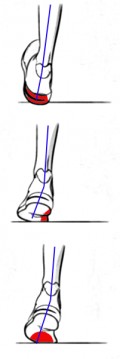
When you take a step, you'll probably notice that your ankle will roll somewhat through your stride, as your weight is distributed across your foot. People with 'normal' or natural pronation will have a slight inward roll. The heel hits the ground, and the weight is distributed along the inside arch of your foot. Those with overpronation experience a larger than normal degree of 'roll' with each stride, meaning that your full body weight is distributed across the extreme inner edge of your foot.
The diagram to the right shows how overpronation happens visually. The red shows where the weight is distributed through the stride. The blue line indicates the angle of your ankle. Overpronation can range from very mild to severe.

The Damage, and How Overpronation Runners Help

Overpronation puts excessive strain on the ankle, knees and hips, and it stretches ligaments and tendons in ways that aren't compensated for by the body. Injuries caused are usually the 'wear and tear' variety that get gradually worse over time, and repairing this damage can be costly.
If you're unsure of whether you require running shoes for overpronation or not, you might want to get someone to video or photograph your stride from behind as you run. Another solution is to look at the wear patterns on your runners. If you see excessive wear on the inside portion of the shoe, you may be overpronating.
People who are heavier or overweight have a higher likelihood of overpronation, as do those with low arches.
The best running shoes for overpronators help by lessening the amount of roll that your ankle and foot does on impact and throughout the stride, by providing extra support and stability to even things out. Mild to moderate issues will require standard stability style runners, while severe cases might want to opt for motion control running shoes.

New Balance 940: Stability & comfort

New Balance is a great brand that has really addressed the issue of pronation in many of their running shoes.
The 940 series is one I really like because it's a versatile and comfortable shoe that's pretty light and offers above average stability and support with every stride. I also like this series because it is a running shoe for overpronators that is available for both men and women.
The 940 series addresses the health issues associated with this condition in a few different ways. First off they feature a stability core that helps compensate for excessive foot roll and keep your ankle much more aligned throughout the stride. There is a super absorbent cushioning system that reduces impact shock on your joints and makes running more comfortable.
The shoe also has a slightly more rigid external skeleton that increases stability and helps prevent injury, but it's a mesh that still allows airflow. The effect is a springy stride and lots of energy while you run.
Lighweight and comfortable, available in a number of sizes and for both men and women, the 940 series by New Balance is a good set of overpronation running shoes that are perfect for moderate to severe sufferers.

Saucony ProGrid: Affordable runners for symptom relief

Saucony is another great running shoe brand that has recognized the growing need for overpronation relief. They offer a range called the ProGrid series which is generally intended for treating the symptoms of excessive pronation.
The one I will be showing here is the Triumph 10 model, which is also available for both men and women. This shoe helps guide your foot and ankle throughout your stride, while also keeping your feet secure and cool.
The Progrid Triumph 10 features a heel impact zone and reinforced toe cushioning in the front, which gives a nice feeling of energy and bounce with each stride you take, while reducing impact and absorbing shock that could cause joint wear over time.
The shoe is designed to reduce 'slippage', which means you'll get fewer blisters on long runs. They fit snugly but not uncomfortably so.
It compensates nicely for roll so anyone who suffers from mild to moderate overpronation could definitely benefit from a pair of these awesome running shoes. Overpronators will also love that they look great and they're pretty lightweight and cool.

ASICS Gel-Kayano 21: Memory foam comfort & stability

ASICS is a slightly more expensive brand than some of the others listed here, but they're obsessed with shoe technology and they make an excellent, long term choice. They are one of the best running shoes for overpronation because they combine all the stability and support you'll need with light weight, air flow and good looks.
The Gel-Kayano 21 series is also available for both men and women. The Gel in the name stands for a type of memory foam in the heel and front of the shoe which conform to your shape and provide awesome reduction of shock and overall comfort while you run. The mesh upper portion of the shoe is built to breathe and does an excellent job of letting air in to the shoe while you run.
Overpronation is dealt with by using their 'Guidance Trusstic' system, which provides increased gait guidance to protect your feet from rolling.
Really these shoes fit like a glove and are a good choice for anyone seeking the top running shoes for overpronators on the market today. They're available in a ton of color choices too, which is always a nice thing.

Mizuno Wave Paradox: Running shoes suitable for severe overpronation

I wanted to feature runners for anyone who suffers from moderate to severe overpronation. If you do, you'll want a set of motion control running shoes that actively work to counteract the excessive roll in your gait.
The Wave Paradox series by Mizuno is a nice example of how a control running shoe can still be comfortable and attractive.
The main difference is in the midsole and heel, which include shock absorbing technology and responsive polymer construction that work to respond to the motion of your foot. Their SmoothRideTM system is meant to reduce excessive motion through your stride and make the transition from heel to toe a lot more stable.
Despite the fact that this shoe is a bit beefier than some of the products shown earlier, it is not actually that much heavier, and a fun and durable running shoe for moderate to severe overpronators that will make most runners very happy. It's available in men and women's sizes

Brooks Adrenaline: Motion control running shoes for severe overpronators

Brooks has a couple of shoes that are really great options for anyone with moderate to heavy overpronation and low arches. They are not the same product but they're effectively quite similar. I really like these runners because they look great and they have a 'free' feeling when you run (many running shoes for overpronators will make you feel 'locked in', not always a great feeling).
The main mechanism for counteracting excess foot roll is the use of diagonal roll bars in the sole. They basically work to make the sole of the shoe a lot more rigid than a standard runner.
They also offer adaptive cushioning, which varies the cushioning depending on where precisely your weight is distributed. The segmented Crash Pad allows a lot of cushioning for lower arches and gives you a spring in your step with each stride.
The Adrenaline is available for both men and women. Both are great options and make excellent running shoes for heavy overpronators or those with lower arches to their feet. Read some customer reviews to get a feel for how popular they are.
Source: http://hubpages.com/sports/Top-5-Running-Shoes-For-Overpronation-Reviews-and-Tips